Many B2B companies still receive paper checks from customers, even when most of their outgoing payments run over ACH or wire. Remote deposit capture (RDC), where a business scans checks at its own office and sends the images to its bank, is a common way to handle them. This article summarizes what the Federal Reserve and the FDIC say about the legal basis for check images, what a substitute check is, where RDC risk sits, and which questions are reasonable to ask your bank. It is informational only.
What remote deposit capture is
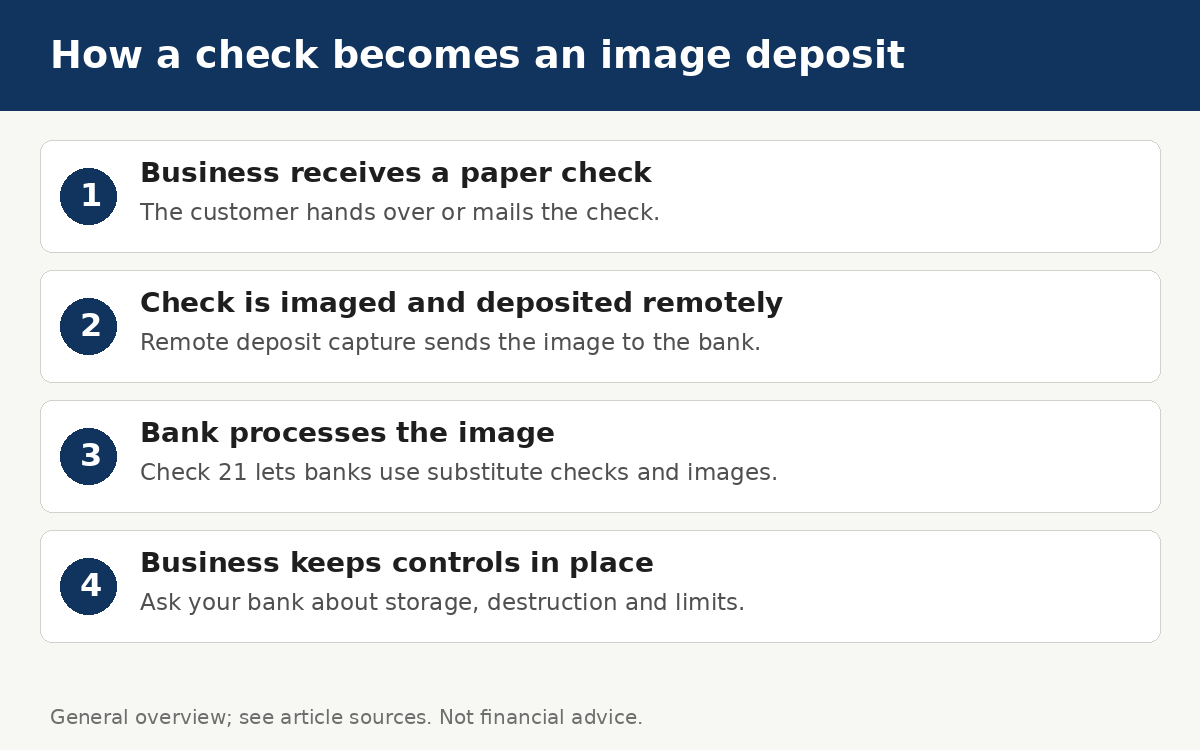
The FDIC’s remote deposit capture primer describes RDC as a service that lets a customer, usually a merchant, deposit checks electronically from a remote location such as its office. The paper check is scanned, and the image is transmitted to the bank for deposit. The FDIC identifies the Check Clearing for the 21st Century Act (“Check 21”) as the law that created the “substitute check” and enabled this kind of processing.
What Check 21 does, and what it does not do
According to the Federal Reserve Board’s Check 21 frequently asked questions, the law was signed on October 28, 2003, became effective on October 28, 2004, and reduced legal barriers to check truncation by creating a new negotiable instrument called a substitute check.
The substitute check
The Federal Reserve describes a substitute check as a paper copy of the front and back of an original check, printed to specific standards. It is the legal equivalent of the original only if it accurately represents the original, carries the required statement (“This is a legal copy of your check. You can use it the same way you would use the original check.”), and has been handled by a bank. The Federal Reserve Bank of Boston’s Check 21 overview makes a related point: a check image on its own is not legally equivalent to the original check, even if it includes the same statement.
No obligation to accept electronic checks
The Federal Reserve states that the law “does not require banks to accept checks in electronic form.” In practice, this means your bank decides whether to offer RDC, on what terms, and for which customers. Those terms are set by your deposit and RDC agreements, not by Check 21 itself. The Boston Fed adds that Check 21 does not impose requirements on banks to retain original checks, so retention expectations for the paper you scan typically come from the agreement with your bank.
Consumer protections are framed around consumers
The Federal Reserve and Boston Fed materials describe the expedited recredit procedure and the required disclosures in terms of consumers who receive substitute checks. Those pages do not address business accounts directly. If your company wants to know what protections apply to it when a check is wrongly charged or returned, that is a question for your bank and your counsel rather than something to assume from the consumer provisions.

How checks move once they are images
The Federal Reserve Banks’ Check 21-enabled services FAQ explains that in an electronic check processing environment the paper is converted to an image and processed electronically. Each item carries MICR line data, front and rear images, and electronic indorsements. Those indorsements are represented in addenda records rather than printed on the check, and the FAQ states that an electronic indorsement has the same legal effect as a printed one. The same FAQ notes that images that fail image quality standards, or carry invalid routing numbers, may be rejected.
For a business, the practical takeaway is that image quality and correct data capture are part of the deposit process, not an afterthought. A poor scan can become a rejected item and a delayed deposit.
Where the risk sits in RDC
The FDIC primer says fraud is the primary risk, because once deposits happen outside the bank’s own “trusted zone,” the bank no longer has direct control over the physical item. It lists operational risks that businesses should recognize in their own workflow:
- Redeposit and duplicate presentment. The same check could be deposited more than once, for example at the office scanner and again through a mobile app or at a branch.
- Poor image quality. The FDIC recommends tracking it because it can cause items to be rejected or fail to clear.
- Altered or forged endorsements and counterfeit items.
- Weak customer authentication and data security gaps around the scanner, the software and the user accounts.
- Vendor reliability when a third party supplies the RDC technology.
Controls the FDIC primer recommends for the customer
The primer lists several customer-side practices that a finance team can map to its own procedures:
- Endorse items in a way that prevents redeposit, such as a restrictive endorsement stating the item was deposited by RDC.
- Separate duties and use dual controls over deposits, so the person who scans is not the only person who reconciles.
- Train the employees who handle deposits.
- Secure the scanner and the RDC system, both physically and logically.
- Follow the limits in the RDC agreement on individual items, daily totals and minimum image quality.
- Accept periodic audits of operational controls, which the primer says may be independent audits in some cases.
On the original paper, the primer says the RDC agreement should set a record retention period for deposited items and require proper disposal when it ends, because checks contain names, addresses, bank names and account numbers that identity thieves can use. The primer does not specify a retention length, so the period comes from your agreement with the bank.

Where the legal framework extends beyond Check 21
The FDIC also points to Regulation CC, which governs funds availability, and Regulation J, which governs check collection and funds transfers through the Federal Reserve Banks. It also mentions state law, clearinghouse rules, agreements between the parties, and Bank Secrecy Act and anti-money laundering obligations. Your bank’s RDC agreement is where these usually become concrete for a business customer.
Questions to ask your bank
- Which items does the RDC service accept, and what are the item and daily deposit limits in our agreement?
- What are the image quality requirements, and how are rejected items reported to us?
- What endorsement is required, and how does the bank detect duplicate presentment across channels?
- How long must we retain original checks, and what disposal method does the agreement require?
- What happens, and who bears the loss, if a deposited item is later returned or found to be a duplicate?
- Does the bank audit or review our deposit procedures, and what would it ask to see?
- Which of our own controls (dual control, user access, scanner security) does the agreement expect us to maintain?
Where this fits with other B2B check controls
RDC is a deposit-side control question. The payer-side equivalent is covered in our article on positive pay and check fraud, and our comparison of paper checks and ACH looks at the cash flow side. For what happens when a payment needs to be reversed, see recalling a B2B payment.
Where a merchant account broker fits
Bridge Capital Partners helps businesses compare merchant account and payment processing options. If your company is trying to reduce the volume of paper checks it handles, it is reasonable to ask providers which electronic receipt methods they support alongside card acceptance, and how those compare with your current check workflow.
Sources
- FDIC, Remote Deposit Capture Primer (checked 15 October 2026)
- Federal Reserve Board, Frequently Asked Questions about Check 21 (checked 15 October 2026)
- Federal Reserve Financial Services, Check 21-Enabled Services Frequently Asked Questions (checked 15 October 2026)
- Federal Reserve Bank of Boston, Check 21 overview (checked 15 October 2026)
This content is for general informational purposes only and is not financial, legal, tax or investment advice. Payment rules, fraud patterns and bank practices change, so consult your bank, payment provider or a qualified professional about your specific situation.
Need Help With Payment Processing?
Talk to our team about rates, gateways, and solutions for your business.
Get a Free Quote →