Informational only. This article is general education about payment formats, not legal, tax, accounting or financial advice. Confirm requirements with your bank, your ODFI or processor, and qualified counsel before changing how you send or receive payments.
When a business pays another business by ACH, the money is only half of what the receiver needs. Accounts receivable also has to know which invoices the payment covers, whether any were short-paid, and which discounts or credits were taken. If that information does not travel with the payment, someone ends up matching deposits to invoices by hand. The ACH network has a built-in answer for this, and it comes down to which entry format the payment uses. This guide explains the difference between CCD, CCD+ and CTX entries, what each can carry, and how to decide what to ask your bank or processor for.
The problem: a deposit with no context
Picture a distributor that receives a single deposit from a customer that had eleven open invoices. Without remittance detail, the deposit amount is just a number. Staff must find the customer’s email, read an attached PDF, and key the application into the accounting system. Multiply that by dozens of customers and the work is slow and error-prone. The fix is to attach the remittance detail to the payment itself, or at least to deliver it through a channel that can be matched to the payment automatically.
Three ways to send a corporate ACH payment
ACH payments between companies commonly use two Standard Entry Class codes defined in the Nacha Operating Rules: CCD (Corporate Credit or Debit) and CTX (Corporate Trade Exchange). A CCD payment that includes one addenda record is often called a CCD+.
CCD
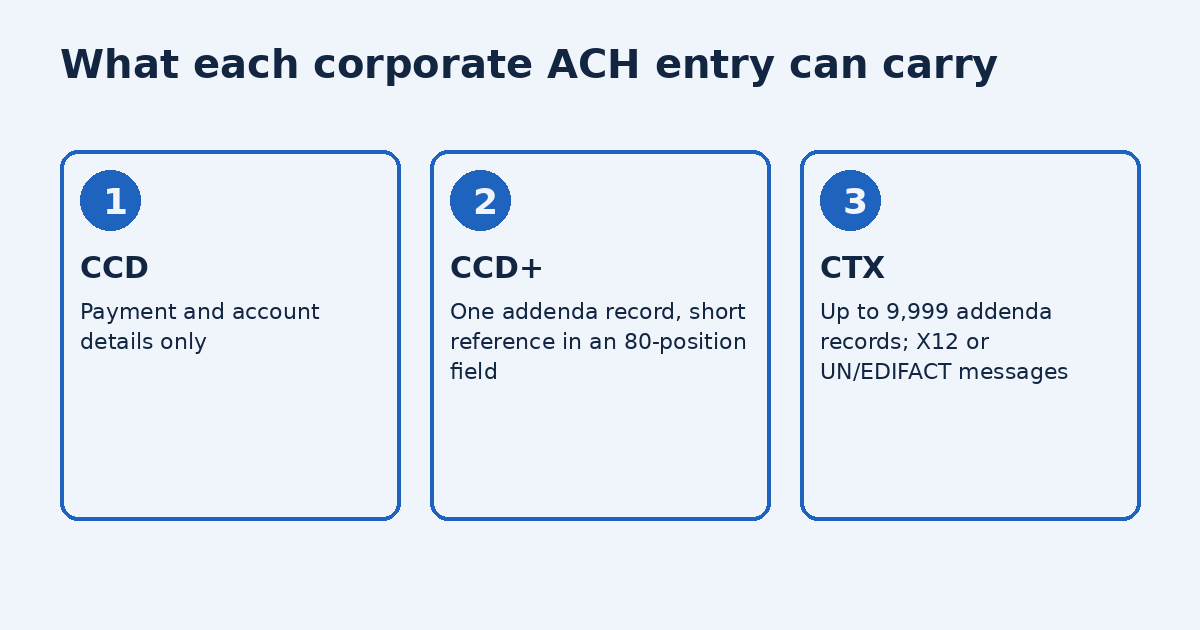
CCD is the basic corporate entry. It moves funds between business accounts and is widely supported by banks and payment software. By itself it carries only the information in the entry detail record, such as the amount, the receiver’s name or identification, and the account details. For simple payments, that is enough.
CCD+ (CCD with one addenda record)
According to Nacha’s published convention guidance, a CCD entry “may be accompanied by only one Addenda Record.” That single addenda can carry X12 data segments or elements, or Nacha-endorsed banking conventions, in an 80-position payment related information field. In practice, 80 characters can hold something like an invoice number reference or a short remittance code, but not a full invoice-by-invoice breakdown for a large payment.
CTX
The same Nacha document states that the CTX format “allows for the provision of 9,999 Addenda Records,” and that those addenda may be used to carry certain X12 transaction sets or UN/EDIFACT messages in their entirety. The X12 820 Payment Order/Remittance Advice is the example Nacha cites. That means a single CTX payment can carry structured detail for many invoices, adjustments and credits, in a format an EDI-capable receiver can read without human intervention.
Comparing the options
| Format | Addenda records allowed | What it can carry | Best fit |
|---|---|---|---|
| CCD | None required | Payment and account information only | Simple, one-invoice payments |
| CCD+ | One | Short references in an 80-position field, X12 segments or elements | Payments needing a reference number or short code |
| CTX | Up to 9,999 | X12 transaction sets or UN/EDIFACT messages in full | Multi-invoice payments between EDI-ready trading partners |
Questions to ask before you choose
- Can your bank or processor originate CTX? Not every originating institution offers every entry class, and software support varies. Ask directly, and ask about any file-format or setup requirements.
- Can the receiver accept and use it? The receiving bank must be able to deliver the addenda information, and the receiving company needs software that can read it. If the customer cannot parse an 820, the extra data adds no value.
- How will remittance reach the receiver? Some banks deliver addenda through a reporting portal, while others forward it through a separate remittance service. Clarify how the data is delivered and how it is matched to the deposit.
- What are the fees? Pricing for addenda-bearing entries and for remittance delivery differs by institution. We are not quoting any numbers here; request a written schedule.
- What authorization applies? Corporate debits and credits are governed by the Nacha Operating Rules and your agreement with your bank. Our guide to ACH debits between businesses covers authorization and return windows in more detail.
How this connects to other payment rails
Remittance detail is not unique to ACH. Wire transfers face a similar question, and the move to ISO 20022 messaging changes how structured remittance information travels on Fedwire; see our overview of Fedwire and ISO 20022. On the card side, enhanced data plays a similar role at the transaction level, which we discuss in Level 2 and Level 3 data processing.
Detail matters for risk as well. When a payment must be reversed or recalled, a clean remittance trail makes it easier to identify exactly what was paid; see recalling a B2B payment. And because fraudsters often impersonate vendors to redirect payments, any change to remittance or banking instructions should go through the verification steps in our piece on business email compromise controls.
A practical way to decide
- If most of your payments settle one invoice at a time, CCD with a reference number may be all you need.
- If a short code or invoice number would remove most manual matching, ask whether CCD+ with a single addenda is supported on both sides.
- If you send or receive large, multi-invoice payments from trading partners that already use EDI, evaluate CTX, and confirm that both banks and both accounting systems can handle it.
- If your partners do not use EDI at all, a simple, consistent email or portal remittance process may serve you better than a more complex entry class.
Bottom line
The entry format is a small technical choice with a large operational effect. CCD moves money, CCD+ adds one short addenda, and CTX can carry structured remittance for many invoices. Choose based on what your counterparties can actually read, and get the capabilities, delivery method and pricing in writing from your financial institution.
Source: Nacha, Third-Party Tax Payments (TPP) Banking Convention, Section III, NACHA Record Formats (document dated 2013; confirm current requirements in the current Nacha Operating Rules). This content is informational only and is not legal or financial advice.
Need Help With Payment Processing?
Talk to our team about rates, gateways, and solutions for your business.
Get a Free Quote →