Few lines on an invoice shape cash flow as much as the payment terms. A short phrase such as “2/10 net 30” tells the buyer when payment is due, and it also offers a reward for paying sooner. For suppliers, the decision to offer that reward is a financing decision in disguise. For buyers, the decision to take it is a return-on-cash question. This article explains how early-pay discount terms work, how to calculate what they are worth, and how the payment method you choose affects timing.
What “2/10 net 30” actually means
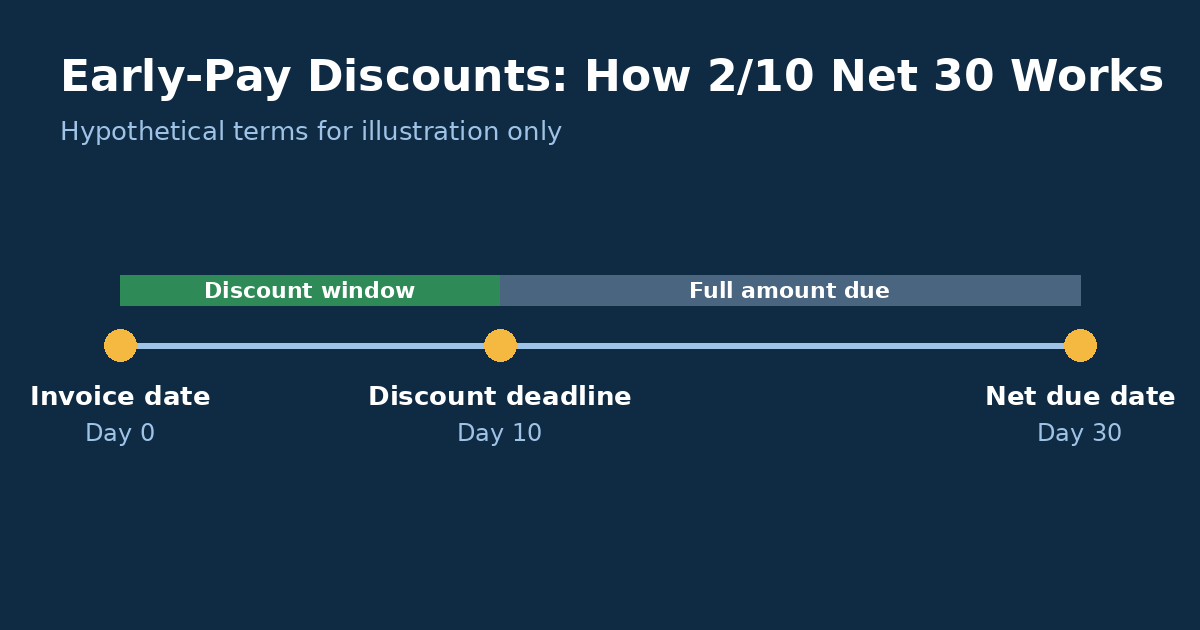
Trade credit terms are written as shorthand. In “2/10 net 30”, the first number is the discount percentage, the second is the number of days in which the discount is available, and the “net” figure is the day the full invoice amount is due. Read aloud: the buyer may deduct 2 percent if the invoice is paid within 10 days of the invoice date; otherwise the full amount is due within 30 days.
Several variations are common in supplier agreements, and the written agreement controls, not the shorthand:
- Invoice date versus receipt date. Some terms count days from the invoice date, others from the date the goods or the invoice were received. The contract or purchase order should say which.
- End-of-month (EOM) terms. Some agreements count the days from the end of the invoice month rather than the invoice date.
- Net-only terms. “Net 30” alone has no discount. Payment is simply due in full by day 30.
- Partial-payment treatment. Agreements differ on whether a discount applies to a partial payment, to freight, or to tax. Check how the supplier’s terms handle each.
The formula: what is the discount worth?
The discount looks small, but it is earned by paying only a few weeks early, so its implied annual cost is much higher than the headline percentage suggests. The standard approach annualizes the discount:
Annualized return = (discount % / (100% minus discount %)) x (365 / (full-payment day minus discount day))
The first part is the return earned on the cash paid early. The second part scales that return to a year based on how many days earlier the buyer pays.
Hypothetical worked example
The following numbers are hypothetical and are used only to show the arithmetic. They are not market data and do not describe any real supplier or buyer.
- Invoice amount: $10,000, on 2/10 net 30 terms.
- Discount if paid by day 10: 2 percent, or $200. The buyer pays $9,800.
- Without the discount, the buyer pays $10,000 on day 30, which is 20 days later.
- Return for paying 20 days early: $200 / $9,800, which is about 2.04 percent.
- Annualized: 2.04 percent x (365 / 20) is roughly 37 percent.
The calculation shows why a buyer with spare cash may find the discount attractive, and why a supplier should understand what it is giving up. A supplier that offers these terms is effectively agreeing to “borrow” at that implied rate from any customer who takes the discount. Whether that is cheaper or more expensive than the supplier’s alternatives, such as a line of credit or waiting for payment, depends entirely on the supplier’s own financing costs. Compare using your own figures.
Who benefits, and what to weigh
For the supplier
- Faster cash. Customers who take the discount pay sooner, which shortens the time receivables are outstanding.
- Margin impact. Every discount taken reduces the revenue collected on that invoice. The discount needs to be priced into the margin from the start.
- Reconciliation workload. Short payments are common when buyers deduct the discount themselves. Clear terms printed on the invoice reduce disputes over whether a deduction was valid.
- Customer mix. Offering discounts to every customer may give away money from customers who would have paid on time anyway.
For the buyer
- Return on cash. Compare the annualized discount with what your cash would otherwise earn or what borrowing would cost.
- Process discipline. A discount is only captured if the invoice is approved and the payment is initiated and arrives before the deadline. Slow approvals can erase the benefit.
- Payment date, not send date. Know whether the supplier’s terms count the date you release payment or the date the funds arrive. The agreement should say.
How payment method changes the timing
The discount deadline is a date, and each payment rail takes a different amount of time to deliver funds. That matters when the deadline is close.
- Paper check. Mail time and deposit processing add days that are outside the buyer’s control. Our comparison of paper checks versus ACH for B2B cash flow covers the tradeoffs. The Federal Reserve’s Regulation CC resources describe the federal framework for when deposited funds must be made available.
- ACH credit. ACH is a batch network, and standard settlement is not instantaneous. Same Day ACH exists for faster settlement within the network’s rules and processing windows. The Federal Reserve Financial Services ACH page describes the FedACH service, and Nacha publishes the ACH Network rules. For limits that are changing, see our article on the Nacha Same Day ACH limit change.
- ACH debit. If a supplier pulls payment, the authorization, timing, and return windows come into play. See our guide to ACH debits between businesses.
- Card payment. Paying by card can let a buyer meet the discount deadline and then defer its own cash outflow to the card statement. For the supplier, accepting card means paying processing costs, which should be compared with the discount being offered. Card data quality can influence the cost; our article on Level 2 and Level 3 data processing explains the enhanced data concept.
Also consider the remittance information that accompanies the payment. A buyer that deducts a discount needs the payment to identify the invoice and the deduction clearly, or the supplier’s accounts receivable team will have to chase the short payment. Our explainer on how B2B ACH payments carry remittance data covers how that information can travel with an ACH payment.
A practical checklist
- Write the terms down. State the discount, the window, the start date for counting days, and which charges the discount applies to.
- Define “paid”. Specify whether the payment counts when it is sent or when it is received.
- Calculate before offering or taking. Run the annualized formula with your own numbers and compare the result with your own cost of funds.
- Match the rail to the deadline. If the window is short, choose a payment method that can reliably arrive in time and confirm its cutoff times with your bank.
- Agree on short-payment handling. Decide in advance how deductions will be communicated and how disputes will be resolved.
- Review periodically. Check which customers actually take discounts and whether the program still serves its purpose.
Bottom line
An early-pay discount is a pricing and financing tool in one phrase. The arithmetic is simple, but the answer depends on each business’s cost of cash, its customers, and how reliably payments move before the deadline. Treat the terms as a deliberate choice rather than a default printed on a template.
This article is for general informational purposes only and is not financial, legal, tax or compliance advice. The worked example is hypothetical and uses made-up numbers for illustration. Payment terms, discounts and payment-method rules vary by agreement, bank and network; consult a qualified professional and your own agreements and financial institutions before making decisions.
Need Help With Payment Processing?
Talk to our team about rates, gateways, and solutions for your business.
Get a Free Quote →