Anyone who originates ACH debits, whether a business collecting invoices, a software company billing customers, or a third-party sender processing for others, eventually learns that returns are not just an operational nuisance. Returns are also a quality signal that the ACH Network watches. Nacha, the organization that writes the ACH rules, publishes return rate levels that can start a review of an originator’s activity. This article explains the three levels Nacha describes, how the rates are calculated, what crossing a level does and does not mean, and how a business can monitor itself before anyone else does.
This article is general information, not financial, legal or compliance advice. Nacha rules change and apply differently to different participants. Confirm current requirements with Nacha’s published materials, your originating bank (ODFI) and qualified counsel.
The three return rate levels
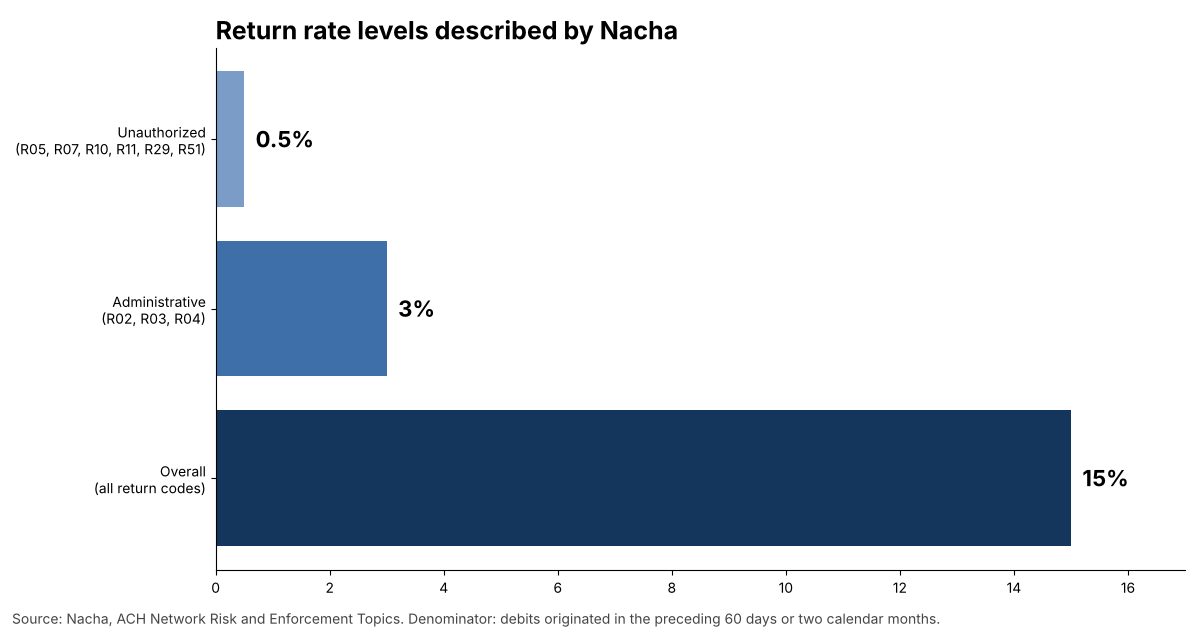
Nacha’s ACH Network Risk and Enforcement Topics page describes three measures. The first is the unauthorized return rate threshold, which Nacha lowered from 1.0 percent to 0.5 percent. The second is an administrative return rate level of 3.0 percent. The third is an overall return rate level of 15.0 percent. The two higher figures are described as levels that can begin a preliminary inquiry rather than as automatic rule violations, and Nacha’s page states that the inquiry process does not automatically trigger Rules enforcement activity (Nacha: ACH Network Risk and Enforcement Topics).
The key distinction is what is being counted. The numbers are not interchangeable, and a business can be comfortable on one and uncomfortable on another.
What counts toward each rate
Nacha’s calculation guides break the measures down by return reason code.
- Unauthorized return rate. The numerator is unauthorized debits returned. Nacha’s guide lists return reason codes R05, R07, R10, R11, R29 and R51 (Nacha: Calculate Unauthorized Return Rate).
- Administrative return rate. The numerator is returns with reason codes R02, R03 or R04, which relate to account problems such as closed accounts or incorrect account information.
- Overall return rate. The numerator is all returns under any return reason code. Nacha’s guide notes that RCK entries and RCK returns may be excluded from both the numerator and the denominator for this overall measure (Nacha: How to calculate administrative or overall return rate levels).
For all three, the guides describe the denominator as debits originated in the preceding 60 days or two calendar months. They also describe an alternative denominator: the debits contained in the files in which the original forward entries were transmitted.
A hypothetical worked example
The numbers below are invented for illustration and are not benchmarks. Suppose a business originates 20,000 debits over the measurement window. If 60 are returned for unauthorized-category reason codes, the unauthorized return rate is 60 divided by 20,000, or 0.3 percent, which is under 0.5 percent. If 500 are returned for R02, R03 or R04 reasons, the administrative return rate is 2.5 percent, which is under 3.0 percent. If total returns of every kind equal 2,400, the overall return rate is 12 percent, under 15 percent. Now change one input: if unauthorized-category returns rose to 120, the unauthorized rate would be 0.6 percent, over the 0.5 percent threshold, even though the business’s other two rates had not moved. The example shows why the unauthorized rate deserves its own line on a dashboard: the threshold is the smallest number, so it is the easiest to cross with few returns.
What happens when a level is exceeded
Nacha’s page says exceeding a level is not automatically a Rules violation and does not automatically trigger a fine. According to the page, a preliminary inquiry may begin when an originator or third-party sender exceeds the administrative or overall level; Nacha may conclude no further action is needed, or it may recommend that an industry review panel require the ODFI to reduce the rate. Fines are described as possible only at the end of an enforcement proceeding.
Nacha’s Risk and Quality Rules fact sheet describes the steps for the unauthorized threshold in more detail. It says Nacha identifies the originator or third-party sender using ACH Operator return data and notifies the ODFI; the ODFI admits or denies the violation; and if an acknowledged rate is above 0.5 percent, the review panel may require a plan for reducing it below 0.5 percent within 30 days, followed by a monitoring period of 180 days. If the rate is not reduced or not maintained, the case can move to Nacha’s System of Fines (Nacha: Improving ACH Network Quality fact sheet). That fact sheet is an older document, so confirm the current process with Nacha and your bank before relying on the specifics.
For an ordinary business originator the practical consequence is usually indirect. The ODFI is the party in the rules relationship with Nacha, so the pressure tends to arrive as questions, reserve or limit changes, or a contract review from the bank.
Why returns happen and which ones you can control
The three rates map to different root causes, which tells you where to look.
Administrative returns (R02, R03, R04) usually trace back to data capture. A customer typed an account number wrong, closed an account, or supplied an account that does not match the name. Fixes are upstream: validate routing numbers, confirm the account before the first debit, and keep a process for updating bank details when a notice of change arrives.
Unauthorized-category returns are about authorization. A customer says they did not approve the debit, revoked approval, or that the debit did not follow the terms they agreed to. For business-to-business debits, our guide to ACH debits between businesses: CCD entries, authorization and return windows covers how authorization and return windows work. Strong written authorization, clear descriptions on the bank statement, and advance notice of changes in amount or date all reduce these returns.
Other returns, such as insufficient funds, add to the overall rate but are not part of the unauthorized or administrative measures. They are the most sensitive to timing, which is one reason payment scheduling relative to your customer’s payroll or billing cycle matters.
How to monitor your own rates
- Agree on the method with your ODFI. Ask which denominator and which window the bank uses so your internal numbers match theirs.
- Track by reason code, not just by count. A flat return total can hide a rising unauthorized share.
- Segment. Break results down by customer, product line, origination channel and sales team. Averages hide outliers.
- Set internal triggers below the public levels. Choose your own alert points so there is time to investigate before a rate approaches a level that attracts attention.
- Close the loop. Feed returns back into onboarding checks, authorization language and notice practices, and document what changed.
- Keep records. Authorizations, notices and return handling should be retrievable if your bank asks.
How this fits with other ACH rules work
Return monitoring is one piece of a wider set of risk expectations. Our overview of Nacha fraud monitoring rules for B2B ACH originators covers the separate fraud-monitoring requirements, and the piece on recalling a B2B payment explains how reversals differ from returns. If you are tracking pending rule proposals, see the June 2027 ACH recredit proposal.
Bottom line
The three numbers Nacha describes, 0.5 percent unauthorized, 3.0 percent administrative and 15.0 percent overall, measure different problems and are calculated from different return reason codes over a 60-day or two-month window. Crossing a level starts a conversation, not an automatic penalty, but the conversation usually runs through your bank. Knowing your own rates by reason code, and knowing what you would say about them, is the inexpensive way to stay ahead of it.
This article is for general informational purposes only and is not financial, legal, tax or compliance advice. The worked example is hypothetical and uses made-up numbers. Nacha rules, thresholds and procedures may change and may apply differently to your situation; verify current requirements with Nacha’s published materials, your originating bank and a qualified professional.
Sources
Need Help With Payment Processing?
Talk to our team about rates, gateways, and solutions for your business.
Get a Free Quote →