Same Day ACH has been available for business payments for years, but the rule that sets how large a single same-day payment can be is about to change. Nacha’s rules currently cap a Same Day ACH payment at $1 million. A Nacha rule page titled “Increasing the Same Day ACH Dollar Limit to $10 Million” states that the limit will rise to $10 million per payment, with an effective date of September 17, 2027. That is not tomorrow, but the planning questions for a business that pays vendors, funds payroll accounts or collects large invoices by ACH start now.
This article explains what is changing, what is not, and how a finance team can prepare. It does not give financial or legal advice, and every detail of your own limits depends on your bank.
What the rule says
According to Nacha, the amendment raises the per-entry dollar limit for Same Day ACH from $1 million per payment to $10 million per payment. The increase applies to all Same Day ACH payments: eligible credits and debits, consumer and business payments, and all three settlement windows. The Federal Reserve Banks’ Same Day ACH resource page confirms the current figure, noting that the earlier increase to $1 million per payment took effect March 18, 2022.
Some entry types are carved out. Nacha notes that other dollar limits for ARC, BOC, POP, RCK and XCK entries still apply, and that international ACH transactions (IATs) remain ineligible for Same Day processing. If your company originates any of those entry types, confirm with your bank that your use case is unchanged.
The settlement windows matter as much as the limit
Nacha’s page tells participants to plan for larger dollar flows settling at 1:00 pm, 5:00 pm and 6:00 pm Eastern Time. Those are the three Same Day settlement times. For a treasury team, that detail changes the shape of the day: a payment that previously had to be split into several smaller transfers to stay under the cap could, after the effective date, move as a single entry that settles in the afternoon.
Which window a payment lands in depends on when your bank submits the file to the ACH operator, and that depends on your bank’s own cutoffs, which are earlier than the network’s. Ask your bank for the internal deadline for each window rather than assuming the network times apply to you.
Your bank decides whether you get the higher limit
A key line in Nacha’s summary is that originating banks (ODFIs) must decide whether to offer higher limits to their business customers. The rule raises the network ceiling. It does not guarantee that your company can send $10 million in one entry. Banks set their own exposure limits for each originator, and they may need software updates and credit reviews before offering larger Same Day amounts.
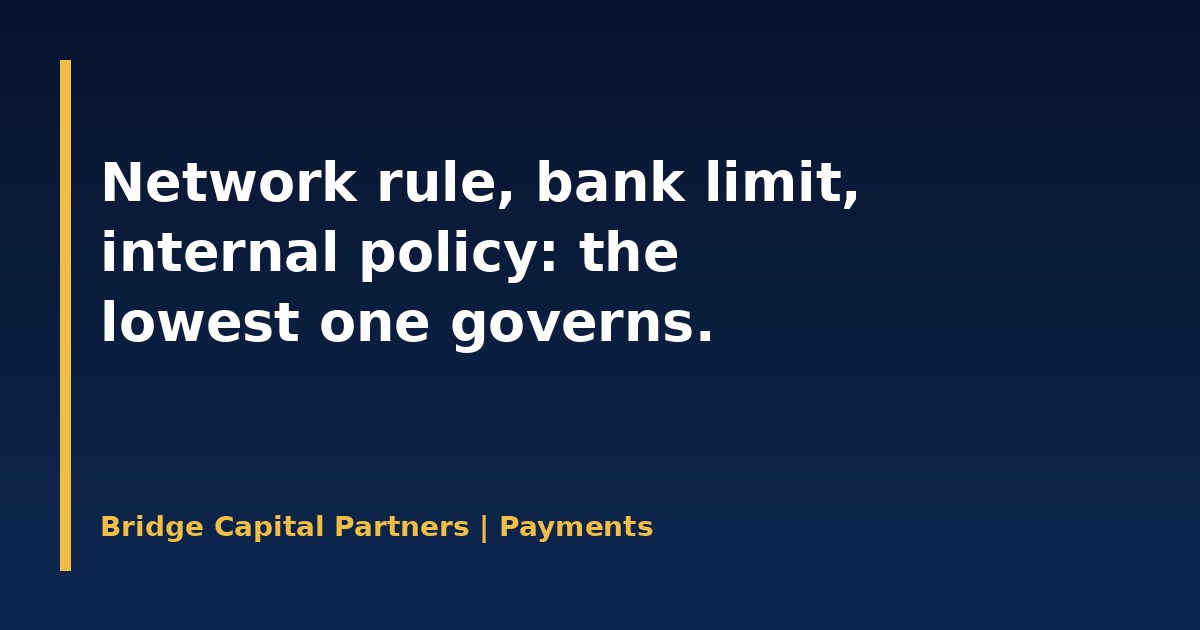
That means your company’s practical limit is the lowest of three things: the network rule, your bank’s approved exposure limit for you, and any limit your treasury policy or approval workflow sets internally. Review all three.
{
}
A practical preparation checklist
Review current usage. Pull a few months of Same Day ACH activity and note how often payments were split to stay under the cap, which windows you used, and whether any were returned. This tells you whether the higher limit matters to you at all. Many companies never come near the current cap.
Talk to your bank early. Ask whether it plans to offer the higher limit, what credit review it will require, whether pricing for Same Day entries changes, and which of your agreements need amending. The conversation is easier a year ahead of the effective date than the week before.
Tighten approval controls. Larger single payments raise the cost of a mistake or a fraud. Consider dual approval above set thresholds, call-back verification for changed bank details, and separation between the person who creates a payment and the person who releases it. These are internal controls, not rule requirements, and they should be sized to your risk.
Check receiving-side readiness. If you collect large invoices by ACH, receiving banks may see bigger afternoon settlements. Nacha tells receiving institutions to prepare for larger, late-day settlements. As a receiver of funds, confirm how your bank posts Same Day credits and when the funds are available for use, since availability rules are set by your bank.
Update your cash forecast. If you plan to shift large vendor payments to Same Day to preserve float or hit a payment deadline, model the effect on your daily balance and on any sweep or line of credit arrangements.
What not to assume
Do not assume the higher limit is live before September 17, 2027. Until that date the $1 million cap applies. Do not assume your bank will offer it. Do not assume that a faster payment is a safer one: Same Day settlement leaves less time to catch an error before funds move. And do not assume the rule changes any other part of the ACH framework, such as return time frames or authorization requirements. Those are covered by separate provisions, and you should read the current Nacha Operating Rules or ask your bank about them.
Questions to bring to your next bank review
Which of our ACH origination agreements reference the Same Day limit? Who at the bank approves exposure limits, and what documentation do they need? How are Same Day entries priced, and does pricing change with size? What are the internal submission cutoffs for each window? What happens if a large Same Day entry is returned? Written answers to these questions make the transition far smoother and give your controller or CFO a clear picture of what is changing for your company.
The headline is simple: the cap will go from $1 million to $10 million on September 17, 2027, and the practical impact depends on your bank and your controls. Start with the data on how you use Same Day today, then plan from there.
Sources
- Nacha, Increasing the Same Day ACH Dollar Limit to $10 Million
- Federal Reserve Financial Services, Same Day ACH Resource Center
Disclaimer: This article is for general informational purposes only. It is not legal, tax, accounting or financial advice, and Bridge Capital Partners does not recommend any specific payment decision. Confirm current Nacha rules, effective dates and your own limits with your bank and qualified professionals.
Need Help With Payment Processing?
Talk to our team about rates, gateways, and solutions for your business.
Get a Free Quote →