This article is general educational information drawn from published IRS materials. It is not legal, financial, tax, or compliance advice, and it does not recommend any product or provider. Tax rules change and individual situations differ, so confirm details with a qualified tax professional.
When a business adds a vendor, most attention goes to the bank details. Our earlier post on verifying a vendor bank account with Micro-Entries covers that side. There is a second piece of vendor onboarding that is easy to overlook because it has nothing to do with how money moves: the tax identification record. This post walks through what the IRS itself says about Form W-9, taxpayer identification numbers (TINs), and backup withholding, so finance teams know which questions to bring to their tax adviser.
What Form W-9 is for
The IRS describes Form W-9 as the form used to give your correct Taxpayer Identification Number to a person who is required to file an information return with the IRS. On its About Form W-9 page, the agency lists examples such as income paid to you, real estate transactions, mortgage interest, and cancellation of debt. In the vendor context, the business making payments is the “requester” and the vendor is the person supplying a TIN.
The current Form W-9 (Rev. March 2024) has a few features worth noticing:
- The form states that the TIN provided must match the name given on line 1 to avoid backup withholding.
- For individuals, the TIN is generally a Social Security number. For other entities, it is generally an employer identification number (EIN).
- Part II is a certification made under penalties of perjury, including a statement that the vendor is not subject to backup withholding. The form tells the signer to cross out that item if the IRS has notified them they are currently subject to backup withholding for failing to report all interest and dividends.
The form’s instructions also describe a $50 penalty on a person who fails to furnish a correct TIN to a requester, unless the failure is due to reasonable cause and not willful neglect.
What backup withholding means for the payer
IRS Tax Topic 307 explains that, when it applies, backup withholding requires a payer to withhold tax from payments not otherwise subject to withholding. According to the page, backup withholding can apply to most kinds of payments reported on Form 1099, including commissions, fees, or other payments for work performed as an independent contractor (Form 1099-NEC) and payment card and third party network transactions (Form 1099-K).
The page says the payer must withhold at a flat 24% rate when any of the following happens:
- the payee does not give the payer a TIN in the required manner;
- the IRS notifies the payer that the TIN given is incorrect;
- the IRS notifies the payer to begin withholding because the payee underreported interest or dividends, which the IRS says it does only after mailing the payee four notices over at least a 120-day period; or
- the payee fails to certify that it is not subject to backup withholding for underreporting of interest and dividends.
The full explanation is on the IRS page Topic no. 307, Backup withholding, which also points readers to Publication 1281 for details.
What happens when the IRS says a name and TIN do not match
IRS Publication 1281, Backup Withholding for Missing and Incorrect Name/TIN(s) is written for payers who file information returns. The copy we reviewed is marked Rev. 12-2023, so check the IRS site for a newer edition before relying on any detail. In it, the IRS describes a notice process that begins when a payer receives a CP2100 or CP2100A notice about a missing or incorrect name and TIN combination:
- Missing TIN. The publication treats a TIN as missing if it is not provided or is obviously incorrect, such as one with more or fewer than nine digits or a mix of digits and letters. In that case the payer is told to make sure backup withholding has begun and to continue until a TIN is received.
- Incorrect name and TIN combination. For the first notice, the publication says the payer sends a “First B Notice” with a Form W-9 to the payee within 15 business days from the date of the CP2100 or CP2100A notice or the date the payer received it, whichever is later. Backup withholding begins on payees who do not return a signed Form W-9 no later than 30 business days after that date.
- Second notice. A second CP2100 or CP2100A within a three-calendar-year period leads to a Second B Notice, which tells the payee to contact the IRS or the Social Security Administration. The publication says the payer must receive validation of the payee’s name and TIN combination afterward. It does not include a new Form W-9.
Pub. 1281 also mentions an IRS TIN Matching program for payers of income reported on several 1099 forms. Whether a business is eligible is a question for the IRS and its tax adviser.
Where the 1099 reporting threshold fits
The IRS Instructions for Forms 1099-MISC and 1099-NEC (the version we reviewed shows a 12/2026 revision) state that, for tax years beginning after 2025, the minimum threshold amount for reporting certain payments and performing backup withholding on those payments increased to $2,000, and may be adjusted for inflation beginning in calendar year 2027. The instructions also say you may use Form W-9 to obtain a payee’s TIN.
That threshold is only one input. Which payments are reportable, on which form, and whether a vendor is exempt depend on the facts of each case, which is a matter for a tax professional.
Questions a finance team might bring to its adviser
- At what point in vendor onboarding does our process collect a W-9, and who owns that step?
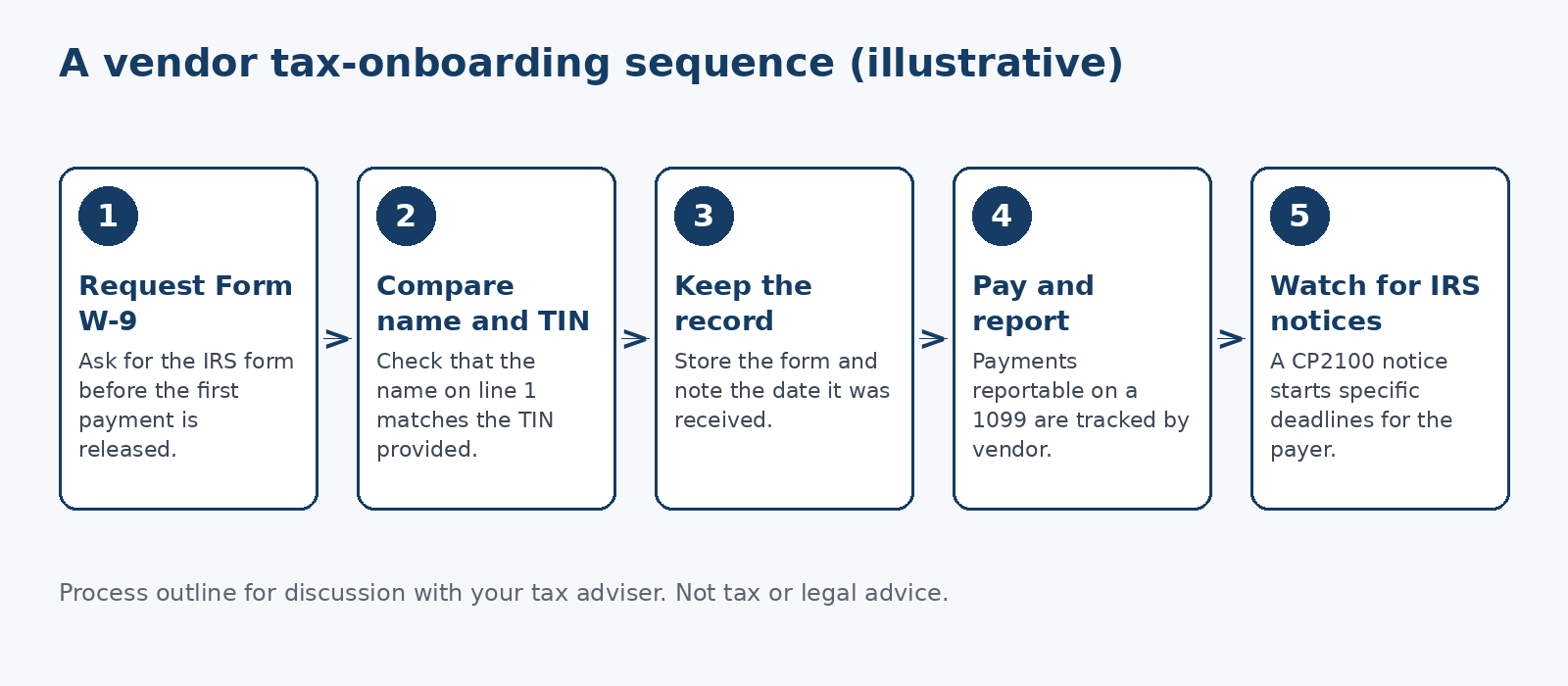
- How do we compare the vendor’s name and TIN, and how do we handle a W-9 that looks incomplete?
- Which of our vendor payments are reportable, and which vendors might be exempt?
- If we received a CP2100 notice, who would see it, and how would the 15 and 30 business-day clocks in Pub. 1281 be tracked?
- How do we protect the W-9s themselves, since they contain TINs?
Vendor tax data is also a social-engineering target. A request to “update” a vendor’s tax or bank details by email deserves the same scrutiny as any other change request, as our post on business email compromise and vendor-change controls explains.
Key takeaways
- The IRS describes Form W-9 as the way a payee gives a payer its correct TIN, with a certification made under penalties of perjury.
- IRS Topic 307 says backup withholding applies at a flat 24% rate in the situations it lists, including when a payee does not provide a TIN in the required manner.
- Pub. 1281 sets out the CP2100 and B-notice process, including 15 and 30 business-day timelines, for incorrect name and TIN combinations.
- The 1099-MISC and 1099-NEC instructions state a $2,000 reporting and backup-withholding threshold for tax years beginning after 2025.
- Rules and thresholds change. Treat this as a starting point for a conversation with a qualified tax professional.
Sources
- IRS, About Form W-9, Request for Taxpayer Identification Number and Certification
- IRS, Form W-9 (Rev. March 2024)
- IRS, Topic no. 307, Backup withholding
- IRS, Publication 1281, Backup Withholding for Missing and Incorrect Name/TIN(s)
- IRS, Instructions for Forms 1099-MISC and 1099-NEC
Disclaimer: Bridge Capital Partners provides general information about payment processing. Nothing in this article is legal, financial, tax, or compliance advice or an offer to provide any service. Consult your bank, processor, or qualified professional about your specific situation.
Need Help With Payment Processing?
Talk to our team about rates, gateways, and solutions for your business.
Get a Free Quote →