This article is general information, not legal, financial, tax, or compliance advice. Bridge Capital Partners does not provide advice on your specific situation. Consult qualified counsel and your financial institution about your agreements.
Business owners often assume that the dispute and refund rights they enjoy on a personal debit card or checking account follow them into the business. In many cases they do not. This article explains, using primary sources, where the federal consumer electronic-fund-transfer rule stops, and what that means for how a business should think about payment risk.
What Regulation E actually covers
Regulation E (12 CFR Part 1005) implements the Electronic Fund Transfer Act. The Consumer Financial Protection Bureau’s published text of section 1005.2 defines the terms that set its reach. It defines “account” as a demand deposit (checking), savings, or other consumer asset account held directly or indirectly by a financial institution “and established primarily for personal, family, or household purposes.” It defines “consumer” as “a natural person.”
Section 1005.3(a) then states that the part applies to electronic fund transfers that authorize a financial institution to debit or credit a consumer’s account. Read together, those definitions tie the rule to the purpose of the account and the identity of the account holder. A company’s operating account is, by its nature, not established primarily for personal, family, or household purposes, and a company is not a natural person.
Whether a particular account or transaction falls inside or outside the rule can depend on facts, such as how an account was opened and used. Treat the paragraph above as a starting point for a conversation with counsel, not a conclusion about your account.
Why this matters for B2B payments
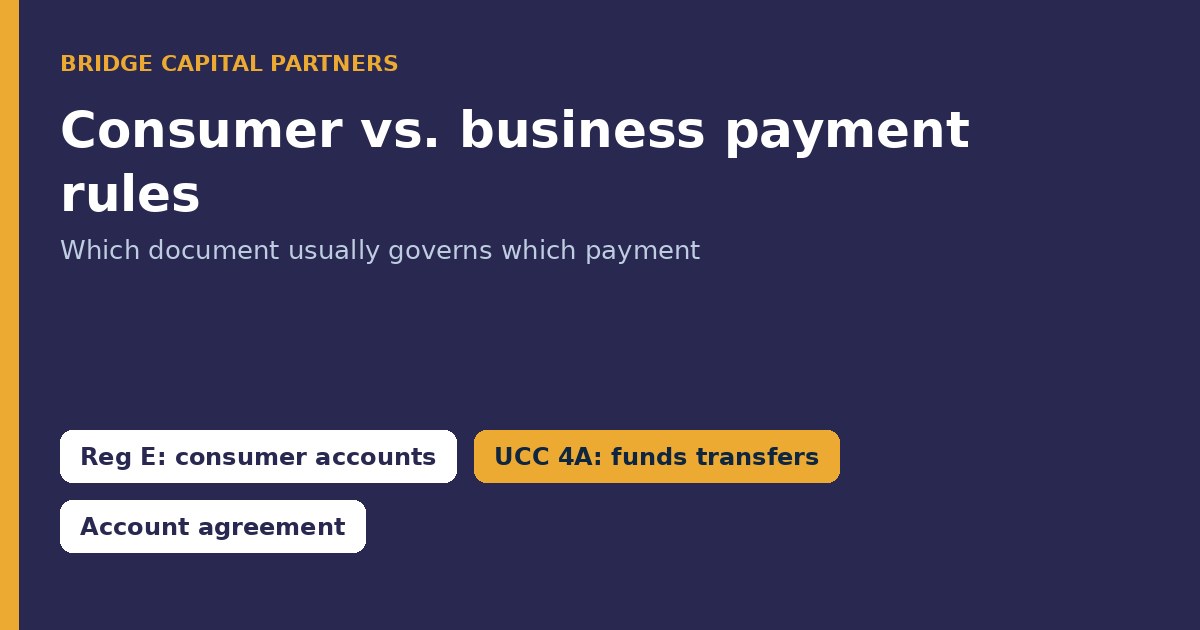
If Regulation E’s consumer error-resolution and unauthorized-transfer framework is not the thing governing a business payment, then other documents do the work: the deposit account agreement, the treasury or merchant services agreement, the rules of the payment network involved, and, for certain funds transfers, state law. The practical consequence is that a business’s protections are frequently more contractual and more dependent on its own reporting discipline than a consumer’s.
Funds transfers and Article 4A
Many wire transfers are governed by Article 4A of the Uniform Commercial Code, as adopted by each state. Two provisions illustrate how different the business framework is. Under UCC 4A-202, a payment order is treated as the sender’s if it was authorized, or if the bank and customer agreed to a security procedure that is a commercially reasonable method of providing security against unauthorized payment orders and the bank proves it accepted the order in good faith and in compliance with that procedure. Under UCC 4A-204, a bank that accepts an unauthorized payment order must refund the payment, but the customer can lose the right to interest if it fails to use ordinary care or does not notify the bank within a reasonable time not exceeding 90 days after receiving notification of the debit. The text allows parties to set the reasonable time by agreement.
We covered the security-procedure concept in more depth in our article on UCC Article 4A and wire transfers. Note that these provisions address funds transfers, not every payment type a business uses.
Checks, wires, and other exclusions in the rule’s text
Coverage turns on more than the account holder. Section 1005.3(c) of the CFPB’s published text says the term “electronic fund transfer” does not include a transfer of funds originated by check, draft, or similar paper instrument. It also excludes transfers through Fedwire or a similar wire transfer system “used primarily for transfers between financial institutions or between businesses.” The official commentary adds that if a bank makes a transfer to a consumer’s account after receiving funds through Fedwire, the ACH leg to the consumer account is covered even though the wire leg is exempt. For a business, the lesson is that a single payment journey can cross several legal regimes, and the leg that reaches your account may not be the leg that carries any federal error-resolution right.
What the consumer framework looks like, for contrast
Section 1005.6 sets tiered limits on a consumer’s liability for unauthorized electronic fund transfers. The CFPB’s text describes three tiers, tied mainly to how promptly the consumer reports the loss or theft of an access device: if the consumer notifies the institution within two business days after learning of the loss or theft, liability is limited to the lesser of $50 or the unauthorized transfers made before notice. The official commentary adds that no agreement between the consumer and the institution may impose greater liability than those limits. Those are consumer rules. A business reading its own agreement should not assume that equivalent caps, equivalent reporting windows, or an equivalent ban on contract terms to the contrary exist for its accounts. If your agreement is silent or says otherwise, that is a question for your bank and your counsel.
Questions to put to your bank and processor
- Which agreement governs unauthorized or erroneous debits on each of our business accounts, and what notice deadlines does it set?
- For ACH debits and credits, which network rules and which return windows apply to our account type? (See our overview of recalling a B2B payment.)
- What security procedures are we bound to for wires and online banking, and who in our company holds the credentials?
- Does anyone reconcile business accounts daily, so that a problem is noticed inside the notice period in our agreement?
- What are our controls against vendor-impersonation fraud? (See our article on business email compromise.)
Operational habits that follow from the framework
Because a business generally cannot assume consumer-style error rights, the most useful controls are ordinary ones: reconcile frequently, separate the people who initiate payments from the people who approve them, call back vendors on a known number before changing bank details, and read the notice provisions in your account agreements before you need them. None of these is a guarantee against loss, and none replaces advice from your own counsel and bank.
Sources
- CFPB, Regulation E, 12 CFR 1005.2 Definitions
- CFPB, Regulation E, 12 CFR 1005.3 Coverage
- Cornell Legal Information Institute, UCC 4A-202 Authorized and Verified Payment Orders
- Cornell Legal Information Institute, UCC 4A-204 Refund of Payment and Duty of Customer to Report
Disclaimer: This content is for general informational purposes only and is not legal, tax, accounting, investment, or financial advice. Payment rules vary by account type, state, and agreement. Bridge Capital Partners is not a law firm or financial advisor. Consult a qualified professional before acting.
Need Help With Payment Processing?
Talk to our team about rates, gateways, and solutions for your business.
Get a Free Quote →