

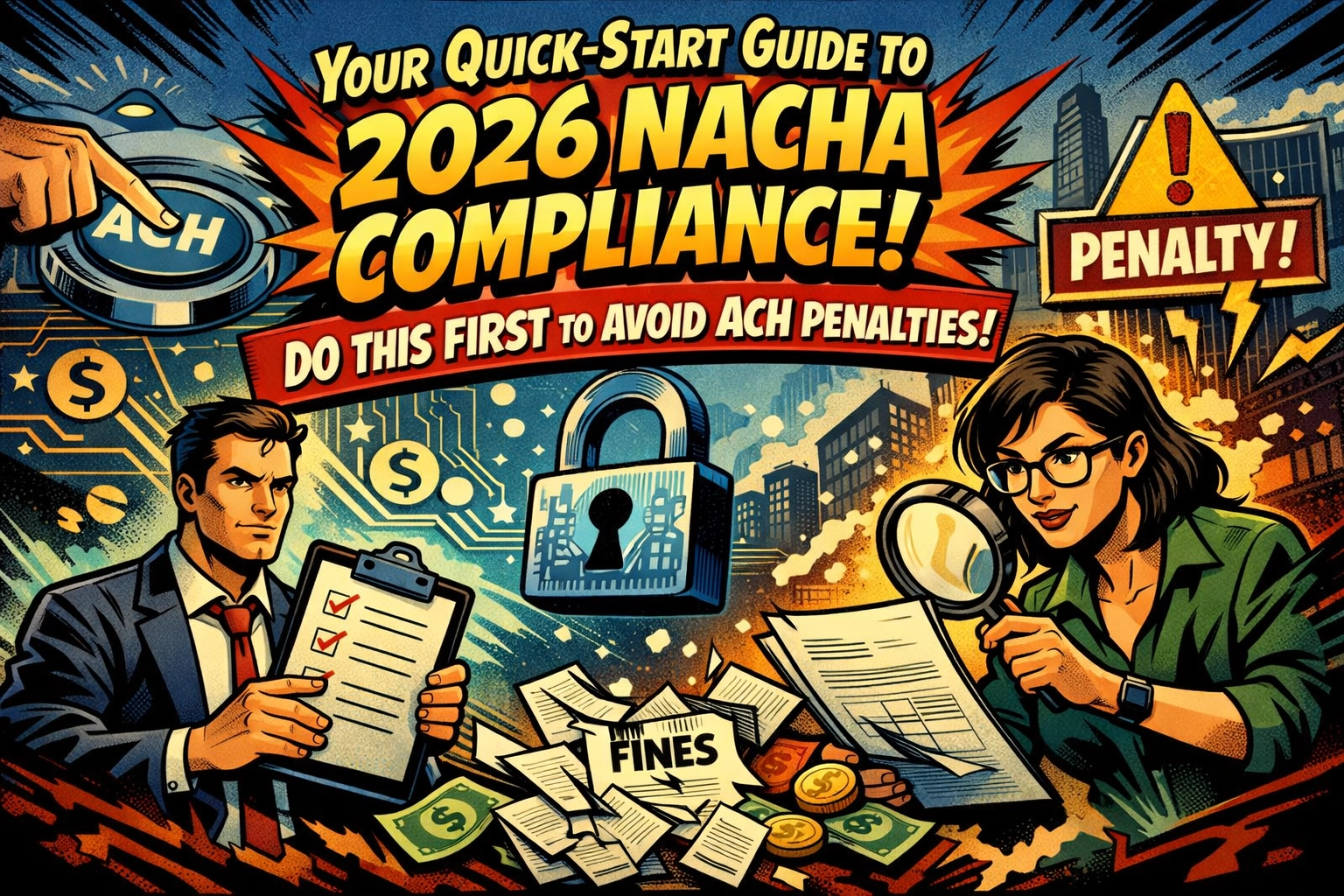
Contact Bridge Capital Partners now for immediate assistance with ACH payment processing and compliance audits.
- Call us: Contact Page
- Explore solutions: ACH & Check Processing
- Check pricing: Merchant Account Rates
The March 20, 2026, deadline for Phase 1 Nacha compliance is almost here. If you process high volumes of ACH transactions, the window for preparation is closing. Failure to meet these new fraud monitoring standards will result in fines, increased scrutiny, and potential suspension from the ACH network. Act now to secure your cash flow.
The 2026 Nacha Compliance Mandate: What Just Happened?
Nacha has updated its rules to combat the rising tide of sophisticated payment fraud. The 2026 amendments focus specifically on "Risk-Based Monitoring" for all ACH participants. This is not a suggestion. It is a mandatory framework requiring originators, ODFIs, and third-party service providers to implement systems that detect fraudulent activity before it clears the network.
The core of the change involves two specific types of fraud:
- Unauthorized Transactions: Classic "theft" where a transaction is initiated without any permission.
- False Pretenses Fraud: The "new" headache. This includes social engineering, business email compromise (BEC), vendor impersonation, and payroll diversion.

Comic book style: A digital detective using a glowing blue magnifying glass to scan a stream of binary code and paper checks, searching for a hidden "fraud" villain.
Are You in Phase 1? Check Your Volume Now
Not everyone hits the March 20 deadline, but if you are big, you are on the clock.
- Phase 1 (Deadline: March 20, 2026): This applies to ODFIs (Originating Depository Financial Institutions), non-consumer originators, and third-party service providers with a 2023 ACH origination volume of 6 million or greater. It also applies to RDFIs (Receiving Depository Financial Institutions) with 10 million or more receipts in 2023.
- Phase 2 (Deadline: June 19, 2026): This covers all other ACH participants regardless of volume.
If you meet the 6 million transaction threshold, you have days, not weeks, to comply. If you are unsure of your volume, review your 2023 processing statements immediately or contact our experts to help you audit your status.
Immediate Priority: The "Do This First" Checklist
To avoid the Nacha hammer, follow these steps in order of importance. Do not skip to step five without completing step one.
1. Identify Your Phase 1 Obligation
Run your reports. If your 2023 volume exceeded 6 million entries, you are in the "Danger Zone." If you are a smaller merchant, you have until June, but you should still implement these changes now to avoid a last-minute crisis.
2. Evaluate Your Current Fraud Monitoring
Your current "standard" fraud filter is likely insufficient. Nacha now requires "risk-based" monitoring. This means your system must be able to flag anomalies that suggest a user is being tricked (False Pretenses).
- Does your system flag a sudden change in vendor bank account details?
- Does it flag payroll batches that deviate from historical norms?
- If not, you are out of compliance.
3. Consult Your Payment Processor
Reach out to your financial partner. At Bridge Capital Partners, we help merchants navigate ach payment processing requirements and ensure that the underlying technology supports these new logic-based filters. Your processor should be your first line of defense.

Comic book style: A powerful superhero (The Processor) standing guard over a digital vault, holding a shield that reflects incoming "Fraud" lightning bolts.
The Deep Dive: Understanding "False Pretenses"
The 2026 rules specifically target "False Pretenses" because traditional filters miss them. In a "False Pretenses" scenario, the transaction is "authorized" in the technical sense: the business owner clicked "send": but they were tricked into doing so.
Examples include:
- Vendor Impersonation: A hacker emails your accounting department pretending to be a regular supplier, asking to update their ACH routing info. You send the payment to the hacker's account.
- Payroll Diversion: An employee’s email is hacked, and a request is sent to HR to change their direct deposit info.
Nacha compliance now requires you to have a "risk-based" process to catch these. This means looking at transaction patterns, entry classes, and recipient history. It is no longer enough to just check if the funds are there; you must check if the transaction makes sense.
Step-by-Step Implementation for High-Volume Originators
If you are a high-volume originator, your compliance program must be documented. If Nacha audits you and you don't have a written policy, you will be penalized even if you haven't had a single fraud event.
Assemble Your Compliance League
You need a cross-functional team. This isn't just an "IT problem."
- Accounting/Finance: To monitor the actual money flow.
- Legal/Compliance: To ensure the documentation meets Nacha's specific wording.
- Cybersecurity: To implement the technical filters.
- Management: To sign off on the risk appetite.
Create a Documented Fraud Monitoring Program
Your written program must outline:
- How you identify high-risk entries.
- What happens when a red flag is raised (e.g., manual review, step-up authentication, or an automatic 24-hour hold).
- Who has the authority to release a flagged transaction.

Comic book style: A team of diverse heroes sitting around a high-tech conference table, reviewing a glowing hologram of a "Compliance Strategy" document.
Why High-Risk Merchants Need to Pay Extra Attention
If you operate in a high-risk industry: such as debt collection, gaming, or certain e-commerce sectors: you are already under a microscope. High-risk ach payment processing usually carries higher return rates, which already triggers Nacha's interest.
The 2026 rules add another layer of complexity. If you are already labeled as "high risk," your "risk-based monitoring" must be even more robust. You cannot afford to have a loose compliance framework. For more on managing these complexities, see our guide on high-risk credit card processing rates and how they intersect with ACH.
The Penalties of Procrastination
What happens if you ignore the March 20 or June 19 deadlines?
- Nacha Fines: These can scale quickly depending on the severity and duration of the non-compliance.
- Loss of Credibility: Your ODFI (bank) may decide you are too much of a liability and terminate your merchant account.
- Network Suspension: In extreme cases, you could be banned from using the ACH network entirely.
- Fraud Losses: Without these new monitoring standards, you remain vulnerable to "False Pretenses" fraud, which is often unrecoverable once the funds leave the network.

Comic book style: A business owner looking at an empty safe while a "Nacha Penalty" notice glows red on their computer screen.
Leveraging Technology for Compliance
You don't have to do this manually. Modern software integrations can automate much of the risk-based monitoring required by Nacha. By using AI-driven logic, these systems can compare every transaction against years of historical data to spot the one "False Pretense" entry in a sea of millions.
At Bridge Capital Partners, we offer various merchant account features designed to streamline this process. From advanced payment gateways to specific high-risk tools, we ensure your tech stack is an asset, not a liability.
Conclusion: Act Now or Pay Later
The 2026 Nacha compliance rules are a significant shift in how B2B and B2C payments are monitored. Whether you fall into Phase 1 this month or Phase 2 in June, the requirements for risk-based monitoring are the new standard for doing business in the United States.
Don't wait for a penalty notice to arrive.
- Step 1: Verify your transaction volume.
- Step 2: Document your fraud monitoring process.
- Step 3: Partner with a processor that understands the 2026 landscape.

Comic book style: A hero standing tall on a skyscraper, looking out over a peaceful city representing a secure, compliant financial network.
Need help with your ACH strategy?
Bridge Capital Partners provides the expertise and the infrastructure to keep your business running smoothly and compliantly.
- Get a quote: Pricing
- Talk to a human: Contact Us
- Learn more about our team: Who We Are
Ensure your business is protected before the March 20 deadline hits.










Leave A Comment